

Splash Parks, Biofilms And Bacteria: Why Good Water Management Goes Far Beyond What We Can See
By Chris Bateman and Robbie Phillips, STA Tutors
The Daily Mail’s investigation this week into bacterial levels at splash parks and paddling pools should serve as an important reminder to anyone responsible for the operation of swimming pools, splash pads and interactive water features.
The investigation tested water samples from six splash parks and paddling pools and reported some striking results. While reassuringly no E. coli or coliforms were detected, two facilities reportedly recorded total viable counts (TVCs) of more than 10,000 – more than 100 times the level regarded as unsatisfactory by the Pool Water Treatment Advisory Group (PWTAG).
Interestingly, one of the councils involved said its own records showed that both pH and chlorine levels had remained within PWTAG-recommended levels during operating hours, despite the newspaper subsequently reporting a high bacterial count from its sample.
For those of us involved in swimming pool water treatment, that illustrates something I regularly emphasise to operators and learners attending my pool plant courses:
You cannot judge microbiological water quality simply by looking at the water – or from one chemical reading alone.
Clear Water Doesn’t Necessarily Mean Clean Water
Water can appear perfectly clear while microorganisms are still present.
Testing residual disinfectants such as chlorine and other factors such as pH, provides vital information about conditions at a particular moment. It allows an operator to establish whether there is an appropriate disinfectant residual and whether the pH is within the correct range for effective disinfection.
Microbiological testing performs a different but equally important role.
It helps verify whether the overall treatment process – including circulation, filtration, disinfection, cleaning and operational management – is actually working effectively.
Neither should be viewed in isolation.
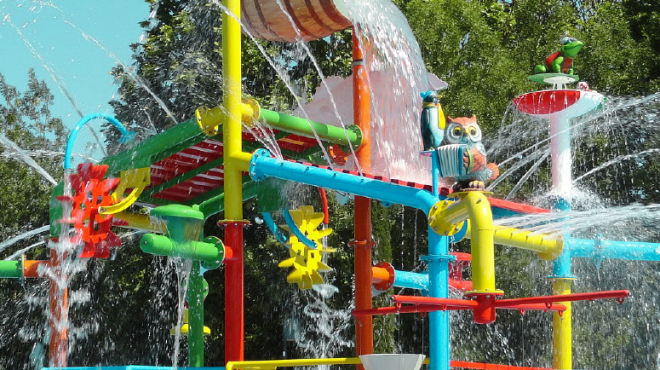
This becomes particularly important with splash parks and interactive water features.
Children run across surfaces barefoot, sit and play around water jets, cover spray nozzles with their hands and inevitably get water in their mouths. Younger children may also be wearing nappies.
Contamination can potentially enter the system from feet, footwear, clothing, nappies, surrounding surfaces, animals and the wider environment.
During exceptionally hot and busy periods, the demands placed on a water-treatment system can increase significantly, particularly as higher temperatures can create more challenging conditions for maintaining water quality.
In many recirculating splash parks, water drains from the play area into a holding tank before being filtered, disinfected and returned to a cleansed tank, then through to the features.
If treatment or management is inadequate, contamination therefore has the potential to be repeatedly circulated through the system.
This is why filtration, circulation, disinfection, cleaning and monitoring all have to work together.
The Hidden Biofilm Problem
Another aspect of the Daily Mail investigation that deserves particular attention is biofilm, which the report highlighted as one possible explanation for high bacterial counts.
I have written previously about biofilms because they are one of the less visible challenges facing swimming pools and other recirculating water systems.
Biofilm is essentially a community of microorganisms that attaches itself to a surface and becomes surrounded by a protective layer.
It can establish itself inside pipework, holding tanks, drains, filters, spray nozzles and other parts of a water circulation system.
Once established, it can be considerably more difficult to control than free-floating microorganisms in the water.
This is why maintaining an appropriate chlorine reading alone should never be regarded as the complete solution.
Disinfection is essential, but good water management must also consider what is happening on the surfaces the water touches and within parts of the system that operators cannot necessarily see. All these areas should be subject to regular physical and chemical cleansing often missed by operators.
When bacteria are detected at the sort of levels highlighted by the Daily Mail investigation, the question therefore shouldn’t simply be:
“How much chlorine is in the water?”
We need to investigate the whole system.
- Is the filtration effective?
- Is circulation adequate to reach all suspect areas?
- How frequently is the water being tested?
- When was microbiological sampling last undertaken?
- When was the holding tank last inspected and cleaned?
- Are filters, drains and spray nozzles being maintained correctly?
- Are there areas where water can stagnate?
- Are there signs of biofilm presence?
- Are there signs of scale formation or corrosion of pipework?
- And crucially, could biofilm be providing an environment in which microorganisms are able to persist within the system? There will always be a Legionella risk linked directly to biofilm presence.
Cleaning and Water Treatment Go Together
Cleaning and water treatment shouldn’t be thought of as two separate jobs.
Tanks, drains, nozzles, filters, pipework and accessible surfaces all form part of the overall water-management picture.
Simply adding more disinfectant is not a substitute for identifying and dealing with contamination or established biofilm.
Cleaning procedures themselves also need to be effective. The correct products, concentrations, methods and contact times all matter.
Biofilm control should therefore be considered as part of preventative water management rather than something operators only think about after receiving an unsatisfactory microbiological result.
Operators should also be aware of the condition of rubber crumb and other safety surfacing. As these materials deteriorate, they may create additional chemical and microbiological considerations that need to be factored into cleaning, maintenance and water-quality management.
New Ways of Tackling Biofilm
The increasing focus on biofilm across the aquatics industry is encouraging because it reinforces the importance of looking beyond conventional day-to-day water readings.
In June 2026, STA announced a strategic partnership with GreenTech International, bringing its Hydro Dioxide® water-treatment solution to the UK aquatics sector through the STA Swim Shop.
Developed and manufactured in the UK, Hydro Dioxide uses chlorine dioxide technology and is designed to target biofilms that can develop throughout circulation systems, including pipework, filters and hard-to-reach surfaces.
This is particularly relevant because these can be precisely the areas that are difficult for an operator to physically inspect or clean during normal operation.
Hydro Dioxide is now available through the STA Swim Shop, providing operators with an additional option when considering biofilm and wider system hygiene.
However, it is important to stress that no chemical treatment should be regarded as a replacement for good pool operation.
Solutions designed to tackle biofilm should form part of an appropriate overall water-management strategy alongside effective filtration, circulation, disinfection, cleaning, chemical testing, microbiological monitoring and maintenance.
The important message is that we need to treat the whole system, not simply the water that we can see.
Reducing Contamination at Source
The Daily Mail investigation also raises another important consideration: user behaviour.
Splash parks are predominantly used by young children and this inevitably creates a significant contamination challenge.
Changing nappies or washing children within the splash area, allowing someone suffering from diarrhoea to use the facility, or children drinking directly from water jets can all potentially increase the contamination entering a recirculating system.
This isn’t about blaming parents.
It is about recognising that good water treatment begins by reducing the amount of contamination entering the water wherever reasonably possible.
Clear signage, suitable changing facilities, using a double nappy system and good public information all have an important role alongside the water-treatment system itself.
What About Cryptosporidium?
The Daily Mail report also raises concerns that splash park water is not routinely tested for Cryptosporidium (‘Crypto’). However, this needs some important context.
Unlike routine chlorine and pH monitoring, Cryptosporidium cannot be tested for in real time at the facility. Testing requires specialist laboratory analysis and is therefore not an immediate operational control.
For operators, the emphasis must instead be on prevention, clear hygiene procedures and an effective response to contamination incidents. Appropriate signage for bathers, including guidance around suitable clothing and toileting, forms an important part of reducing the risk of contamination.
Just as importantly, trained staff must know exactly what to do if a faecal incident occurs.
The release of runny stool should trigger a clear, established response procedure, including closing the affected facility and following the appropriate treatment and management process before it is reopened.
This is another example of why competent operators and robust procedures matter. Water safety isn’t simply about what can be measured at the poolside; it is also about preventing contamination and knowing how to respond when an incident occurs.
Testing Must Be Meaningful
Another point I regularly emphasise during training is that testing should never become a box-ticking exercise.
Recording a chlorine or pH result is useful only if the person carrying out the test understands what that result means and knows what action to take when something isn’t right.
The same applies to microbiological sampling.
Sampling location, timing, handling and interpretation all matter.
A single test provides information about one moment in time.
A well-maintained set of records tells us much more.
Looking at chemical readings alongside microbiological results, maintenance records, filter performance, cleaning schedules, usage levels and incidents can help operators identify patterns and developing problems rather than simply reacting after something has gone wrong.
For example:
- Is the disinfectant residual regularly falling during particularly busy periods?
- Are microbiological results showing a developing trend?
- Is the filtration system performing as expected?
- When was the holding tank last inspected and cleaned?
- Has there been a recurring problem with one part of the system?
Good record keeping allows us to ask these questions before a problem becomes more serious.
Competence Is Just as Important as Equipment
Ultimately, even the best-designed water-treatment system still requires competent people to operate it.
Automated chemical controllers, filtration systems, UV treatment and monitoring equipment can significantly improve water management, but they don’t remove the need for trained operators.
- Someone still needs to understand the readings.
- Someone needs to recognise abnormal conditions.
- Someone needs to inspect the wider system.
- Someone needs to respond appropriately when something isn’t working correctly.
- And, importantly, someone needs to have the confidence and authority to say the facility should not open or should close when safe operating conditions cannot be maintained.
This is why appropriate training is so important.
The STA Level 3 Award in Pool Plant Operations (PPO) is designed for those responsible for the management and maintenance of swimming pools, spas and interactive water features. The qualification covers the knowledge and skills needed to understand water testing, disinfection, pool water chemistry, dosing, mechanical operations and the wider management of pool plant.
As an STA Tutor delivering the Level 3 PPO qualification, one of the messages I continually reinforce is that pool plant operation isn’t simply about learning how to carry out a chlorine and pH test.
The person responsible for the water needs to understand why they are carrying out that test, what the result is telling them and, most importantly, what they should do when the result isn’t what they expect.
A number written in a logbook doesn’t make water safe. Understanding what that number means – and acting on it – is what matters.
The Answer Isn’t to Be Afraid of Splash Parks
Reports about bacteria in recreational water understandably attract attention, particularly when children are involved.
But the message shouldn’t be that families need to fear swimming pools or splash parks.
These are fantastic facilities that encourage children to be active, enjoy the water and have fun.
The important lesson from investigations such as this is that they need to be designed correctly, maintained properly, tested regularly and operated by competent people.
- They need effective circulation and filtration.
- They need appropriate disinfection.
- They need regular cleaning and biofilm management.
- They need meaningful chemical testing.
- They need microbiological monitoring.
- They need good operating procedures and records.
- They need signage guiding parents etc., in safe hygiene before and after use.
And, crucially, they need competent people who understand the water they are responsible for.
What We Can’t See Matters
Perhaps the most important lesson from the Daily Mail investigation is that water safety isn’t simply about what we can see.
A splash park can look spotless.
The water can look crystal clear.
A chlorine reading can appear satisfactory.
But none of those things individually proves that the entire system is microbiologically under control.
Good water management comes from combining effective filtration, circulation and disinfection with cleaning, biofilm control, meaningful testing, microbiological monitoring, good record keeping and properly trained operators.
- Testing tells us what is happening.
- Records help us identify trends.
- Cleaning and biofilm control help us tackle contamination at its source.
- Competent operators bring all of those elements together.
We shouldn’t wait for an outbreak or a newspaper investigation before asking whether a water-treatment system is working properly.
We should be able to demonstrate that it is working every day.
That is how we demonstrate that a system is safe rather than simply assuming that it is.
And when children’s health is involved, that distinction is extremely important.
- Categories
- Association News, Pool Plant